 Add to Chrome
 Add to Firefox
 Add to Edge
Reinforcement Learning from Denoising Feedback
May 25, 2026
Policy loss estimation remains a fundamental and long-standing challenge in reinforcement learning (RL) for diffusion language models (dLLMs). We introduce Reinforcement Learning from Denoising Feedback (RLDF), a novel training paradigm that leverages feedback obtained from rollout and training processes to facilitate accurate and efficient policy loss estimation. To balance the trade-off between computational efficiency and estimation effectiveness, RLDF optimizes the model toward the clipped clean state $\hat{x}_0$ from intermediate noisy states $x_t$, combined with weighted timestep sampling over $t$. Extensive experiments demonstrate that RLDF achieves consistent and substantial improvements in both performance and generalizability across two representative dLLM architectures, LLaDA and Dream, on multiple reasoning benchmarks. Our work lays a principled foundation for scalable reinforcement learning in diffusion language models. We build Drift, a training framework for dLLMs, available at https://github.com/ant-research/Drift.

Knowing but Not Correcting: Routine Task Requests Suppress Factual Correction in LLMs
May 07, 2026LLMs reliably correct false claims when presented in isolation, yet when the same claims are embedded in task-oriented requests, they often comply rather than correct. We term this failure mode \emph{correction suppression} and construct a benchmark of 300 false premises to systematically evaluate it across eight models. Suppression rates range from 19\% to 90\%, with four models exceeding 80\%, establishing correction suppression as a prevalent and severe phenomenon. Mechanistic analysis reveals that suppression is not a knowledge failure: the model registers the error internally but task context diverts early-layer attention from the false claim as output intent crystallizes toward compliance at middle layers. We characterize this as \emph{knowing but not correcting} -- suppression occurs at response selection rather than knowledge encoding. Guided by this mechanism, we propose two training-free interventions. Correction Direction Steering (CDS) estimates a correction-compliance direction from matched pairs and injects it at middle layers before output intent crystallizes. Dynamic Payload Amplification (DPA) localizes payload tokens via attention divergence between early and late layers and amplifies their representation at the final layer, requiring no calibration data. Experiments on Qwen3.5-9B and LLaMA3.1-8B show both methods substantially improve factual strictness. CDS achieves the highest correction rate on Qwen3.5-9B (0\%$\to$58.2\%). DPA is the only method that preserves or improves reasoning capability on both models. These findings introduce \emph{factual strictness} -- the willingness to uphold accuracy against contextual pressures -- as a new dimension of model reliability.
Up to 36x Speedup: Mask-based Parallel Inference Paradigm for Key Information Extraction in MLLMs
Jan 27, 2026Key Information Extraction (KIE) from visually-rich documents (VrDs) is a critical task, for which recent Large Language Models (LLMs) and Multi-Modal Large Language Models (MLLMs) have demonstrated strong potential. However, their reliance on autoregressive inference, which generates outputs sequentially, creates a significant efficiency bottleneck, especially as KIE tasks often involve extracting multiple, semantically independent fields. To overcome this limitation, we introduce PIP: a Parallel Inference Paradigm for KIE. Our approach reformulates the problem by using "[mask]" tokens as placeholders for all target values, enabling their simultaneous generation in a single forward pass. To facilitate this paradigm, we develop a tailored mask pre-training strategy and construct large-scale supervised datasets. Experimental results show that our PIP-models achieve a 5-36x inference speedup with negligible performance degradation compared to traditional autoregressive base models. By substantially improving efficiency while maintaining high accuracy, PIP paves the way for scalable and practical real-world KIE solutions.
EchoingPixels: Cross-Modal Adaptive Token Reduction for Efficient Audio-Visual LLMs
Dec 11, 2025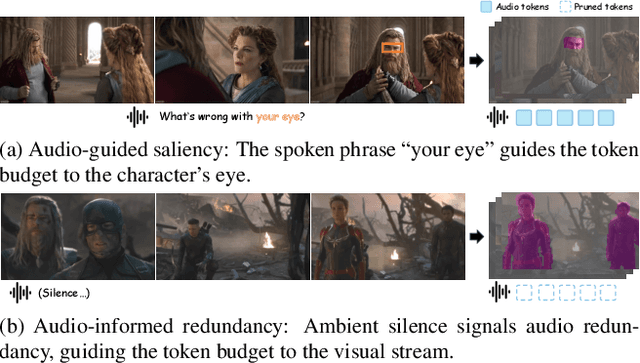
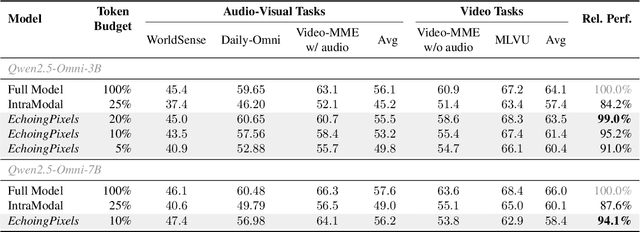
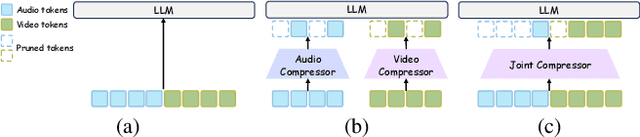
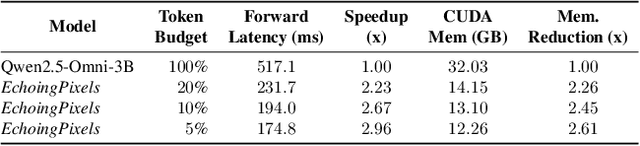
Audio-Visual Large Language Models (AV-LLMs) face prohibitive computational overhead from massive audio and video tokens. Token reduction, while extensively explored for video-only LLMs, is insufficient for the audio-visual domain, as these unimodal methods cannot leverage audio-visual cross-modal synergies. Furthermore, the distinct and dynamic information densities of audio and video render static budgets per modality suboptimal. How to perform token reduction on a joint audio-visual stream thus remains an unaddressed bottleneck. To fill this gap, we introduce EchoingPixels, a framework inspired by the coexistence and interaction of visuals and sound in real-world scenes. The core of our framework is the Cross-Modal Semantic Sieve (CS2), a module enabling early audio-visual interaction. Instead of compressing modalities independently, CS2 co-attends to the joint multimodal stream and reduces tokens from an entire combined pool of audio-visual tokens rather than using fixed budgets per modality. This single-pool approach allows it to adaptively allocate the token budget across both modalities and dynamically identify salient tokens in concert. To ensure this aggressive reduction preserves the vital temporal modeling capability, we co-design a Synchronization-Augmented RoPE (Sync-RoPE) to maintain critical temporal relationships for the sparsely selected tokens. Extensive experiments demonstrate that EchoingPixels achieves performance comparable to strong baselines using only 5-20% of the original tokens, with a 2-3x speedup and memory reduction.
Keep the General, Inject the Specific: Structured Dialogue Fine-Tuning for Knowledge Injection without Catastrophic Forgetting
Apr 27, 2025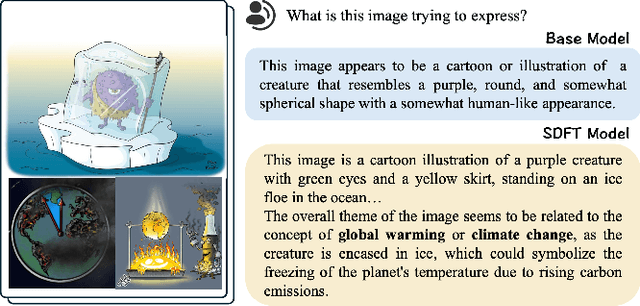
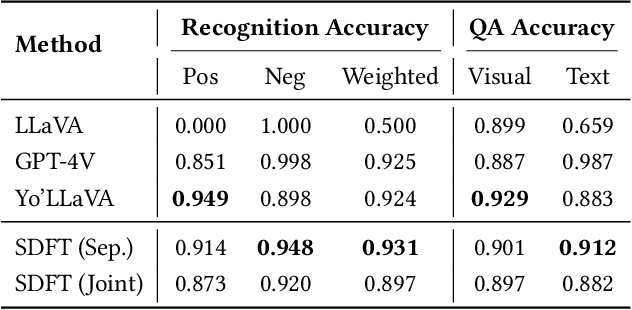
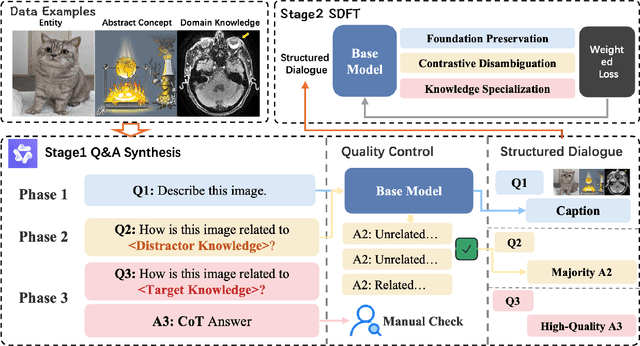
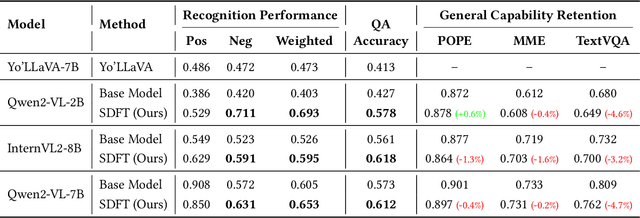
Large Vision Language Models have demonstrated impressive versatile capabilities through extensive multimodal pre-training, but face significant limitations when incorporating specialized knowledge domains beyond their training distribution. These models struggle with a fundamental dilemma: direct adaptation approaches that inject domain-specific knowledge often trigger catastrophic forgetting of foundational visual-linguistic abilities. We introduce Structured Dialogue Fine-Tuning (SDFT), an effective approach that effectively injects domain-specific knowledge while minimizing catastrophic forgetting. Drawing inspiration from supervised fine-tuning in LLMs and subject-driven personalization in text-to-image diffusion models, our method employs a three-phase dialogue structure: Foundation Preservation reinforces pre-trained visual-linguistic alignment through caption tasks; Contrastive Disambiguation introduces carefully designed counterfactual examples to maintain semantic boundaries; and Knowledge Specialization embeds specialized information through chain-of-thought reasoning. Experimental results across multiple domains confirm SDFT's effectiveness in balancing specialized knowledge acquisition with general capability retention. Our key contributions include a data-centric dialogue template that balances foundational alignment with targeted knowledge integration, a weighted multi-turn supervision framework, and comprehensive evaluation across diverse knowledge types.
InsightVision: A Comprehensive, Multi-Level Chinese-based Benchmark for Evaluating Implicit Visual Semantics in Large Vision Language Models
Feb 19, 2025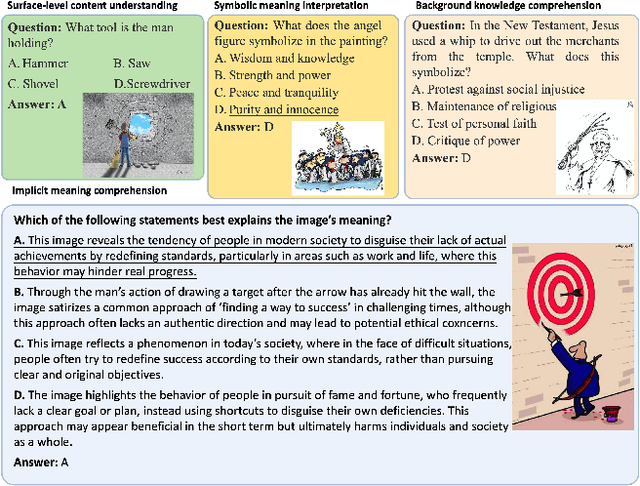
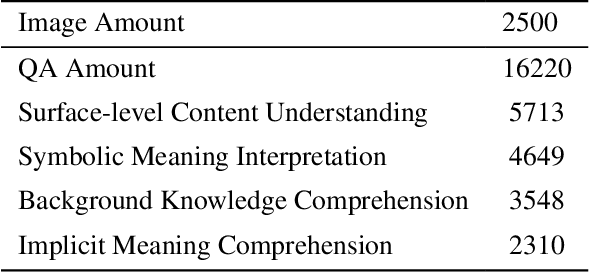
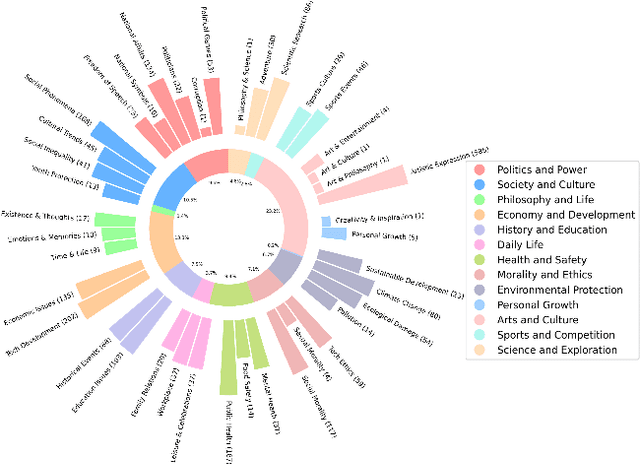
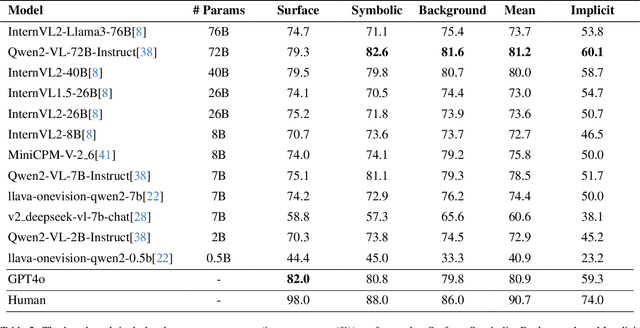
In the evolving landscape of multimodal language models, understanding the nuanced meanings conveyed through visual cues - such as satire, insult, or critique - remains a significant challenge. Existing evaluation benchmarks primarily focus on direct tasks like image captioning or are limited to a narrow set of categories, such as humor or satire, for deep semantic understanding. To address this gap, we introduce, for the first time, a comprehensive, multi-level Chinese-based benchmark designed specifically for evaluating the understanding of implicit meanings in images. This benchmark is systematically categorized into four subtasks: surface-level content understanding, symbolic meaning interpretation, background knowledge comprehension, and implicit meaning comprehension. We propose an innovative semi-automatic method for constructing datasets, adhering to established construction protocols. Using this benchmark, we evaluate 15 open-source large vision language models (LVLMs) and GPT-4o, revealing that even the best-performing model lags behind human performance by nearly 14% in understanding implicit meaning. Our findings underscore the intrinsic challenges current LVLMs face in grasping nuanced visual semantics, highlighting significant opportunities for future research and development in this domain. We will publicly release our InsightVision dataset, code upon acceptance of the paper.
Modeling Layout Reading Order as Ordering Relations for Visually-rich Document Understanding
Sep 29, 2024Modeling and leveraging layout reading order in visually-rich documents (VrDs) is critical in document intelligence as it captures the rich structure semantics within documents. Previous works typically formulated layout reading order as a permutation of layout elements, i.e. a sequence containing all the layout elements. However, we argue that this formulation does not adequately convey the complete reading order information in the layout, which may potentially lead to performance decline in downstream VrD tasks. To address this issue, we propose to model the layout reading order as ordering relations over the set of layout elements, which have sufficient expressive capability for the complete reading order information. To enable empirical evaluation on methods towards the improved form of reading order prediction (ROP), we establish a comprehensive benchmark dataset including the reading order annotation as relations over layout elements, together with a relation-extraction-based method that outperforms previous methods. Moreover, to highlight the practical benefits of introducing the improved form of layout reading order, we propose a reading-order-relation-enhancing pipeline to improve model performance on any arbitrary VrD task by introducing additional reading order relation inputs. Comprehensive results demonstrate that the pipeline generally benefits downstream VrD tasks: (1) with utilizing the reading order relation information, the enhanced downstream models achieve SOTA results on both two task settings of the targeted dataset; (2) with utilizing the pseudo reading order information generated by the proposed ROP model, the performance of the enhanced models has improved across all three models and eight cross-domain VrD-IE/QA task settings without targeted optimization.
UNER: A Unified Prediction Head for Named Entity Recognition in Visually-rich Documents
Aug 02, 2024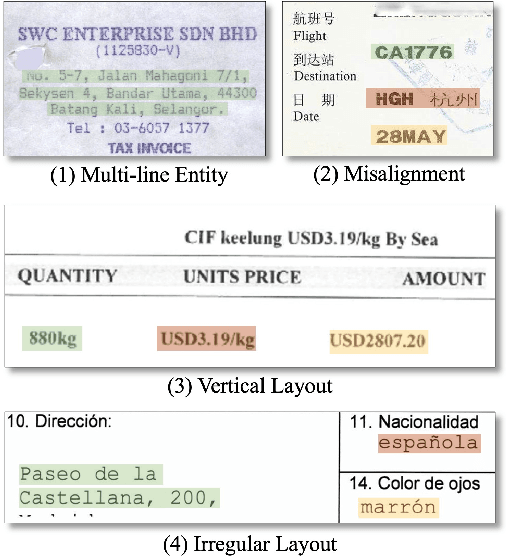
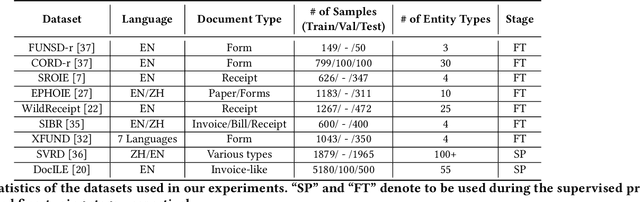
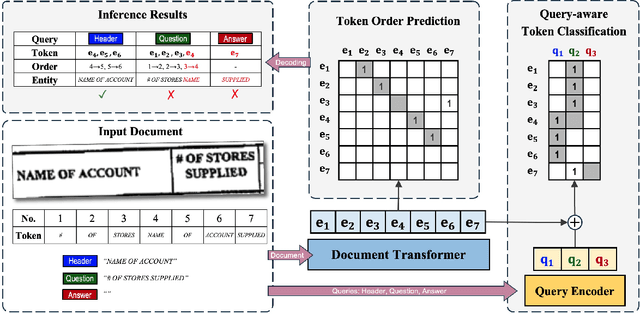
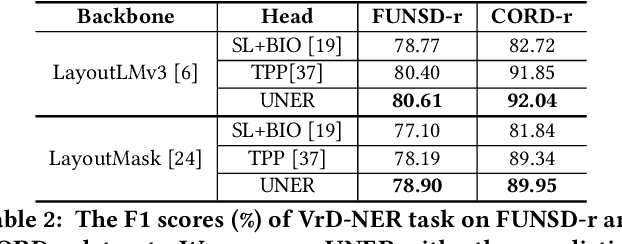
The recognition of named entities in visually-rich documents (VrD-NER) plays a critical role in various real-world scenarios and applications. However, the research in VrD-NER faces three major challenges: complex document layouts, incorrect reading orders, and unsuitable task formulations. To address these challenges, we propose a query-aware entity extraction head, namely UNER, to collaborate with existing multi-modal document transformers to develop more robust VrD-NER models. The UNER head considers the VrD-NER task as a combination of sequence labeling and reading order prediction, effectively addressing the issues of discontinuous entities in documents. Experimental evaluations on diverse datasets demonstrate the effectiveness of UNER in improving entity extraction performance. Moreover, the UNER head enables a supervised pre-training stage on various VrD-NER datasets to enhance the document transformer backbones and exhibits substantial knowledge transfer from the pre-training stage to the fine-tuning stage. By incorporating universal layout understanding, a pre-trained UNER-based model demonstrates significant advantages in few-shot and cross-linguistic scenarios and exhibits zero-shot entity extraction abilities.
Causal Prototype-inspired Contrast Adaptation for Unsupervised Domain Adaptive Semantic Segmentation of High-resolution Remote Sensing Imagery
Mar 06, 2024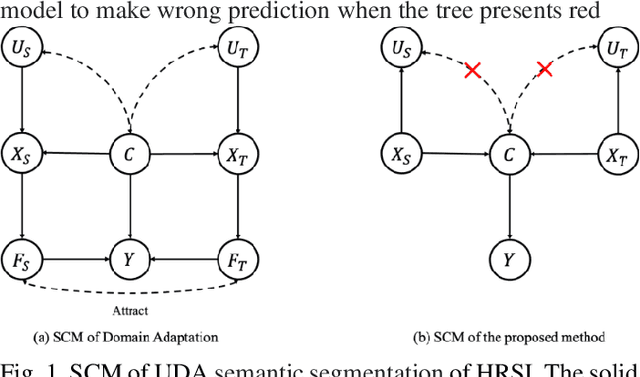
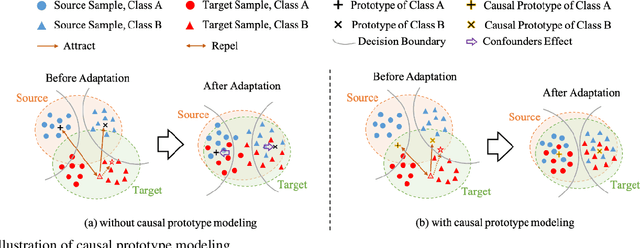
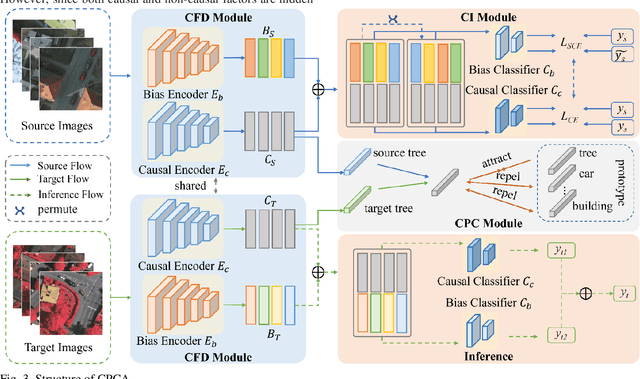
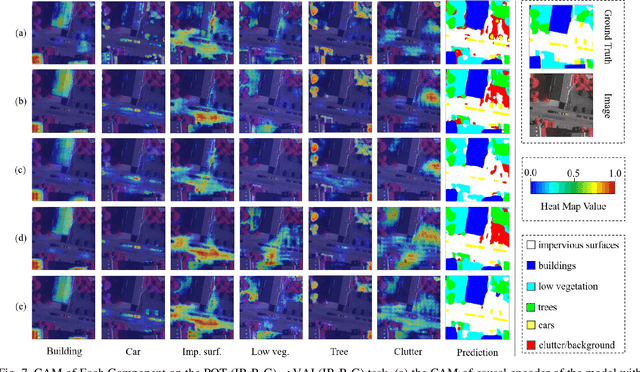
Semantic segmentation of high-resolution remote sensing imagery (HRSI) suffers from the domain shift, resulting in poor performance of the model in another unseen domain. Unsupervised domain adaptive (UDA) semantic segmentation aims to adapt the semantic segmentation model trained on the labeled source domain to an unlabeled target domain. However, the existing UDA semantic segmentation models tend to align pixels or features based on statistical information related to labels in source and target domain data, and make predictions accordingly, which leads to uncertainty and fragility of prediction results. In this paper, we propose a causal prototype-inspired contrast adaptation (CPCA) method to explore the invariant causal mechanisms between different HRSIs domains and their semantic labels. It firstly disentangles causal features and bias features from the source and target domain images through a causal feature disentanglement module. Then, a causal prototypical contrast module is used to learn domain invariant causal features. To further de-correlate causal and bias features, a causal intervention module is introduced to intervene on the bias features to generate counterfactual unbiased samples. By forcing the causal features to meet the principles of separability, invariance and intervention, CPCA can simulate the causal factors of source and target domains, and make decisions on the target domain based on the causal features, which can observe improved generalization ability. Extensive experiments under three cross-domain tasks indicate that CPCA is remarkably superior to the state-of-the-art methods.
Rethinking the Evaluation of Pre-trained Text-and-Layout Models from an Entity-Centric Perspective
Feb 04, 2024Recently developed pre-trained text-and-layout models (PTLMs) have shown remarkable success in multiple information extraction tasks on visually-rich documents. However, the prevailing evaluation pipeline may not be sufficiently robust for assessing the information extraction ability of PTLMs, due to inadequate annotations within the benchmarks. Therefore, we claim the necessary standards for an ideal benchmark to evaluate the information extraction ability of PTLMs. We then introduce EC-FUNSD, an entity-centric benckmark designed for the evaluation of semantic entity recognition and entity linking on visually-rich documents. This dataset contains diverse formats of document layouts and annotations of semantic-driven entities and their relations. Moreover, this dataset disentangles the falsely coupled annotation of segment and entity that arises from the block-level annotation of FUNSD. Experiment results demonstrate that state-of-the-art PTLMs exhibit overfitting tendencies on the prevailing benchmarks, as their performance sharply decrease when the dataset bias is removed.